
Animal dissection in Germany: what applies in schools and universities?
In short
Teaching may lawfully use appropriately sourced dead animals or organs. This does not authorise capturing, killing or experimenting on living animals. Species, origin, educational context, risk assessment and sometimes official approval determine what is allowed. There is no universal list of species anyone may dissect.

Four separate questions
Is the animal already dead? Where did it come from? Is it protected by species-conservation rules? Is the work ordinary school teaching, university teaching or an authorised scientific project? Food-trade material, legally supplied specimens and independently collected wildlife are not equivalent.
Schools
Suitable dead specimens may be used in planned teaching with traceable sourcing, appropriate tools, hygiene, disposal and a risk assessment. Applicable German state rules and the current RiSU school-safety guidance matter.
Non-harmful observation does not authorise harmful experiments. Statutory animal experiments do not belong in ordinary general-education school teaching. Special vocational cases need separate legal assessment and cannot be generalised to every classroom.
| Example | Planning considerations |
|---|---|
| Fish or suitable organ from a traceable food source | May be suitable under local rules; check hygiene, cooling, allergies and disposal. |
| Pig eye | DGUV identifies this as an alternative to cattle eyes; risk assessment still required. |
| Cattle eye in school | DGUV school guidance prohibits dissection because of the relevant prion risk. |
| Wild frog, newt or other wildlife | Not for independent collecting or killing; conservation status and origin decide. |
| Animal found dead | Neither automatically legal nor hygienically suitable; assess possession, species and infection issues. |
| Living squid or another cephalopod | Scientific procedures fall under particularly relevant protections; “invertebrate” is not blanket exemption. |
| Collection specimen | Check sourcing and preservatives; do not handle old taxidermy unchecked. |
These examples are not general procurement permissions. Consult school management, the accident insurer and, where relevant, veterinary or conservation authorities.
An important exception exists in section 45(4) of Germany's Federal Nature Conservation Act: under its conditions, subject to hunting and fisheries law, animals found dead that are not strictly protected may also be used for research, teaching or preparation for those purposes. Species and origin must be checked. A found carcass is neither always prohibited nor always allowed.
Universities
A zoological class may use lawfully supplied dead material. Procedures on living animals can instead be statutory animal experiments. For vertebrates and cephalopods, section 8 of the Animal Welfare Act sets the relevant project-approval framework. Section 7a adds conditions including institutional context, necessity and consideration of alternatives.
Certain killing solely to obtain organs or tissue for scientific use is excluded from the statutory definition of an animal experiment by section 7. That is not unrestricted permission: section 4 and other conditions still apply. Institutional specialists must determine the category, not an individual student improvising.
Since when?
There is no single date when “animal dissection was banned”. Germany's Animal Welfare Act is dated 24 July 1972 and has been amended repeatedly. EU Directive 2010/63/EU dates from 22 September 2010 and includes living cephalopods. The RiSU edition used here is dated 21 September 2023. These dates are not first-prohibition dates for particular classroom dissections.
No unverified nationwide starting date is claimed for the cattle-eye restriction. Current school rules and the relevant hazard assessment govern.
Alternatives
Models, digital specimens, images and existing prepared material may meet some or all learning objectives. Considering alternatives is legally relevant for scientific animal experiments and educationally valuable in schools.
Read instrument selection and hygiene. A dissection kit is equipment, not legal permission. This article concerns Germany, not other jurisdictions.
Questions
- Are all invertebrates freely usable?
- No. Welfare, conservation, source and special rules for certain groups still matter.
- Can I prepare an animal found outdoors for class?
- Do not bring independently sourced material. Have legality, origin and hygiene assessed first.
Read next
 Choosing a dissection kit for biology or medicineChoose the kit that matches your current course list. Biology practicals often emphasise small specimens and …
 Hygiene standards for coats, hands and instrumentsLaboratory hygiene combines organised work, appropriate hand hygiene, suitable clothing and defined procedur …
Sources & further reading
- gesetze-im-internet.de — source and further reading(opens in a new tab)
- gesetze-im-internet.de — source and further reading(opens in a new tab)
- gesetze-im-internet.de — source and further reading(opens in a new tab)
- gesetze-im-internet.de — source and further reading(opens in a new tab)
- gesetze-im-internet.de — source and further reading(opens in a new tab)
- German conservation law, section 44(opens in a new tab)
- German conservation law, section 45 and exceptions(opens in a new tab)
- KMK: German school-safety guidance RiSU(opens in a new tab)
- DGUV: animals and specimens in schools(opens in a new tab)
- EU Directive 2010/63/EU(opens in a new tab)
General guidance for study and teaching. For your actual work, your safety briefing, hygiene plan, lab instructions and the product instructions apply. Legal information refers to Germany.
From our shop
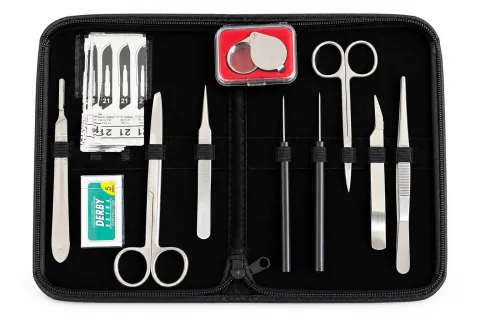 + Dissection Kit "Lorenz" for Biology
4,7 von 5 Sternen (78)
ab 22,99 €
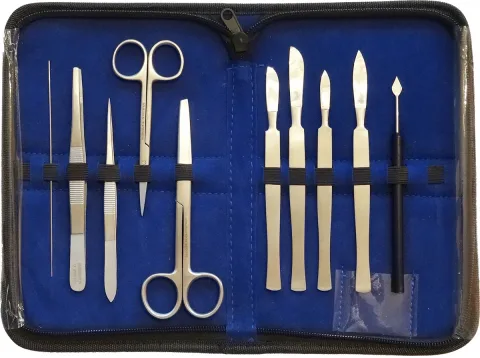 + Dissection Set "Paracelsus" with Fixed Blade Scalpels
4,6 von 5 Sternen (54)
ab 16,79 €
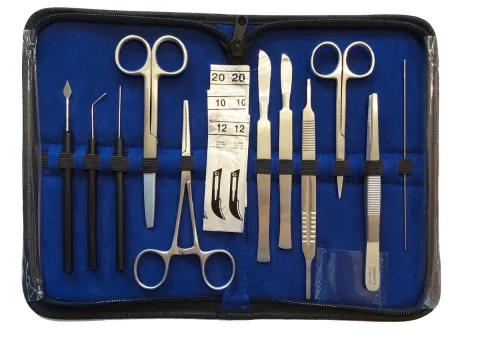 + Dissection Set "Hippocrates" with Fixed and Interchangeable Blade System
4,6 von 5 Sternen (54)
ab 19,29 €
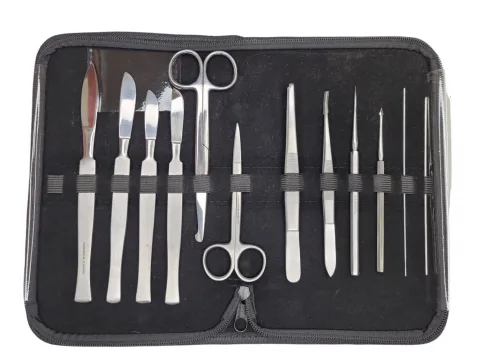 + Dissection Instruments "Harvey" for Medicine
4,7 von 5 Sternen (64)
ab 25,79 €