Which safety eyewear do I need in the laboratory?
In short
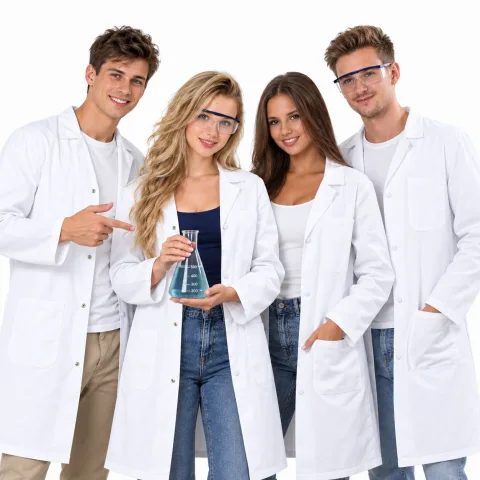
Select eyewear for the actual eye hazard and course rules. Ordinary prescription glasses do not replace required protection. Safety spectacles, over-glasses and goggles have different applications.

Main designs
Safety spectacles typically add lateral coverage to a glasses-style frame. Over-glasses are designed to fit over prescription spectacles. Goggles enclose the eye area more fully. Suitability for a particular splash or particle risk follows from markings, instructions and the local assessment.
“Laboratory glasses” is not a universal performance specification. UV protection does not automatically mean suitability for lasers, intense specialist sources or every wavelength. Those require appropriately matched filters and equipment.
Fit check
- Stable fit without immediate slipping when looking down.
- Comfortable temples and nose support after several minutes.
- Enough space for prescription glasses without pushing protection away from the face.
- Suitable field of vision and lateral coverage.
- Compatibility with other required equipment.
Cleaning without damaging coatings
Start with the manufacturer's instructions. Do not rub dust and particles dry across the lens. Use approved procedures and clean, suitable materials. Solvents and aggressive household cleaners can damage plastics and coatings.
Disinfectants must suit both the purpose and material. Approval for wiping does not imply soaking is allowed. After cleaning check for cracks, damaged supports, clouding and scratches that impair vision.
Markings and standards
Check CE marking, relevant conformity documents and performance for the actual risk. Alongside the formerly widespread EN 166, EN ISO 16321 is relevant. A standards transition does not by itself make existing eyewear unusable merely because its number is older: check product status and institutional rules. Side shields do not automatically provide the same protection as splash-rated goggles.
Read about coats and biology equipment. Browse protective equipment. Manufacturer-specific cleaning approvals do not transfer automatically to other brands.
Questions
- Why do lenses fog?
- Moisture, temperature, fit and ventilation interact. Suitable anti-fog treatment can help; do not modify the glasses yourself to increase airflow.
- Can scratched lenses be polished?
- Only with a manufacturer-approved procedure. Improvised polishing can harm optics and coatings; replace unsuitable lenses or eyewear.
- Which standard must be marked?
- Use current markings, conformity documents and course rules. A number alone does not establish the right design or protection level.
Read next
 Does a lab coat provide enough protection from chemicals?An ordinary coat adds a textile barrier but is not universal chemical protection. Suitability depends on the …
 What equipment do biology students need, and when?Common personal items include a specified coat, suitable eye protection and, for certain classes, a dissecti …
Sources & further reading
General guidance for study and teaching. For your actual work, your safety briefing, hygiene plan, lab instructions and the product instructions apply. Legal information refers to Germany.